
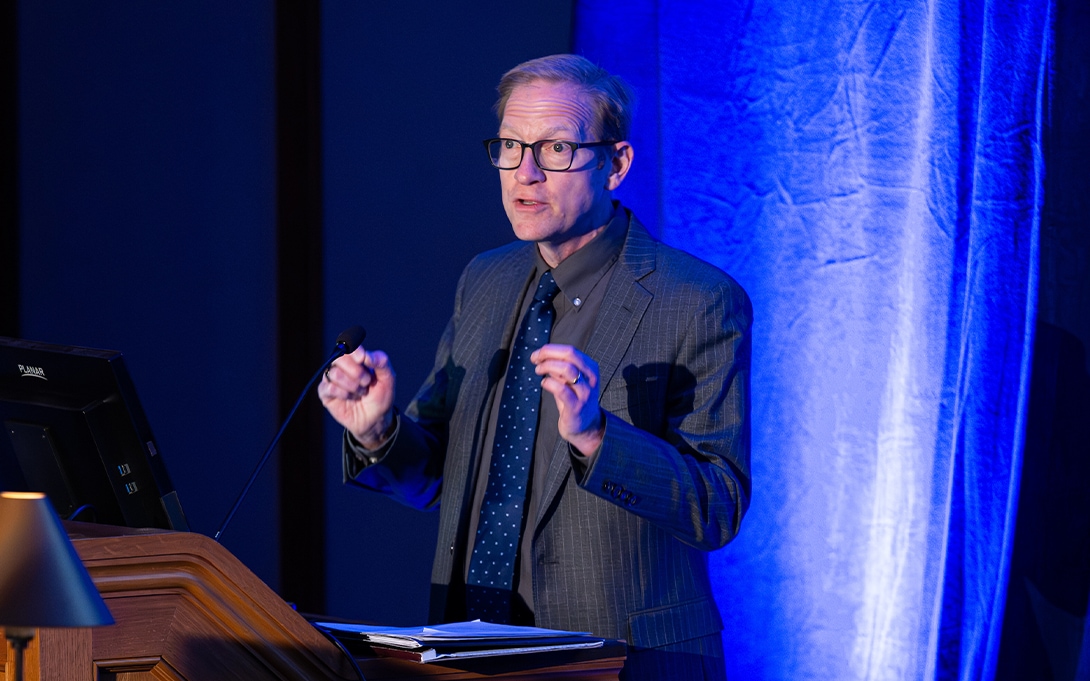
From arguing cases for the Justice Department to investigating why expanded social benefits were rolled back, Samuel Bagenstos explores the intersection of law, policy, and public service
Professor Samuel R. Bagenstos has built his career navigating the intersection of law, policy, and politics—arguing cases for the U.S. Department of Justice, clerking for Supreme Court Justice Ruth Bader Ginsburg, and serving in the Biden administration's Office of Management and Budget.
Today, with dual appointments as the Arlene Susan Kohn Professor of Social Policy and the Frank G. Millard Professor of Law, Bagenstos's research tackles some of democracy's most pressing questions: Why were expanded social benefits rolled back quickly? How has Congress lost control of the federal purse strings? And how can the law protect the rights of people with disabilities?
"Being able to explore ideas surrounding law, policy, politics—and being able to do more deep and exploratory thinking—it's what I love to do," he says.
Bagenstos's interest in public service began in childhood when his mother took a job as an educational evaluator for the U.S. Department of Education. That interest guided his academic path; he majored in political science at the University of North Carolina and earned a law degree from Harvard University.

He then embarked on a series of roles that shaped his understanding of how law and social change influence each other. He clerked for Judge Stephen Reinhart on the Ninth Circuit Court of Appeals in California, spent three years at the Department of Justice's Civil Rights Division arguing appellate cases, and later clerked for Justice Ruth Bader Ginsburg on the Supreme Court.
At the Department of Justice, Bagenstos took on extraordinary responsibility. The National Voter Registration Act had just been adopted as one of President Clinton's major campaign promises, and a group of Republican governors challenged its constitutionality. Bagenstos was assigned as the lead lawyer defending the law. Also during his time at the department, he developed expertise in disability rights cases, defending the Americans with Disabilities Act.
"I was dealing with questions fundamental to our democracy," he says.
Getting to stand up in court and talk about the Constitution was super fun and a great experience. I couldn't have imagined a better string of experiences for a young lawyer."
Bagenstos loved being a lawyer and still does—he's taken several public service leaves from teaching to serve in the executive branch and continues to represent clients in his spare time. But practicing law left him hungry for something more.
"When I was a full-time lawyer, I worked on cases that were super interesting and really meaningful, but they would raise these difficult, far-reaching questions that I didn't have time to explore because my role was to represent my client," he explains.

The desire to dig deeper inspired Bagenstos to move into academia. He continues to work on disability rights, recently releasing the fourth edition of his disability rights law textbook. His writing also explores the relationship between Congress and the executive branch on spending issues, as well as the implementation of social welfare policies. And with America facing what Bagenstos calls "a governance crisis," he's been exploring changes in the structure of government itself.
One of Bagenstos's recent papers, "COVID and the Great Retrenchment," tackles a question that's puzzled political scientists. During the COVID-19 pandemic, Congress dramatically expanded social welfare programs by sending checks to citizens and increasing access to health care. The uninsured rate dropped to seven percent, its lowest ever, and a broad child tax credit cut child poverty in half.
Political science theory suggests that once public services are expanded, it's difficult to scale them back. But Congress rolled back these benefits, and the improvements vanished. The uninsured rate is quickly rising, and child poverty has returned to pre-pandemic levels.
Bagenstos's paper explores several reasons why these benefit expansions didn't stick. It takes time for a policy to become entrenched, and many people didn't recognize the impact of the new benefits. "No one made the case that the policies were really improving lives," he says.
In another forthcoming paper, "The Crisis of Appropriations Law," Bagenstos examines how the system of federal spending and Congress's relationship to the president have broken down.

"A basic pillar of our constitutional order is that Congress controls the purse strings," he says. "What we're seeing now is that Congress has basically been disregarded by the current administration and is not using its tools. That shifts the balance of power toward the president."
With papers like these, Bagenstos explicitly aims to influence policymakers. At other times, he writes to explore ideas. Another recent paper explores health movements like "Make America Healthy Again," opposition to vaccines, and efforts to legalize cannabis and psychedelics. According to Bagenstos, these movements are currently associated with the political right, have previously been linked to the left, and actually have ambiguous political orientations. "The goal is to help people understand and assimilate what's going on in the world," he says.
Bagenstos acknowledges the tension inherent in being both a scholar and an advocate.
I have values that I really care about and commitments in the world that matter to me. I want to seriously explore the ideas that interest me and follow them where they lead."
At the same time, his work is not specifically aligned with any political movement. Ultimately, Bagenstos focuses on applying the best evidence available to questions of law and policy. "As scholars, we have an obligation toward the truth," he says.
In March, the University of Michigan honored Bagenstos with the 2025 President's Award for Public Impact, recognizing his commitment to public service and his contributions that significantly impact society through national and state leadership.
Kohn Collaborative update
The Kohn Collaborative for Social Policy unites exceptional faculty—Luke Shaefer, Pamela Herd, Samuel Bagenstos, and Christina Weiland—and graduate-level Kohn Scholars to advance evidence-based, inclusive policy. This semester, the Collaborative spotlights research and engagement at U-M and beyond.
Learn more about our Kohn Collaborative for Social Policy
Funding
Through a new partnership with state agencies, Weiland drives improvements for Michigan's Early On program by analyzing student outcomes and service delivery.
Herd investigates how fraud accusations become political tools by examining how the demographic makeup of public program participants influences perceptions and punitive responses.
Learning
Monthly seminars led by Kohn Scholars connect social policy experts and graduate students across the Ford School and U-M.
Fall 2026 symposium
The inaugural Social Policy Symposium will bring together policy scholars and practitioners for cross-sector collaboration and impact.
The Collaborative is generously funded by Harold and Carol Kohn.
By Sheri Hall
Related spring 2026 State & Hill stories
 This research is not partisan
  CLOSUP turns 25
 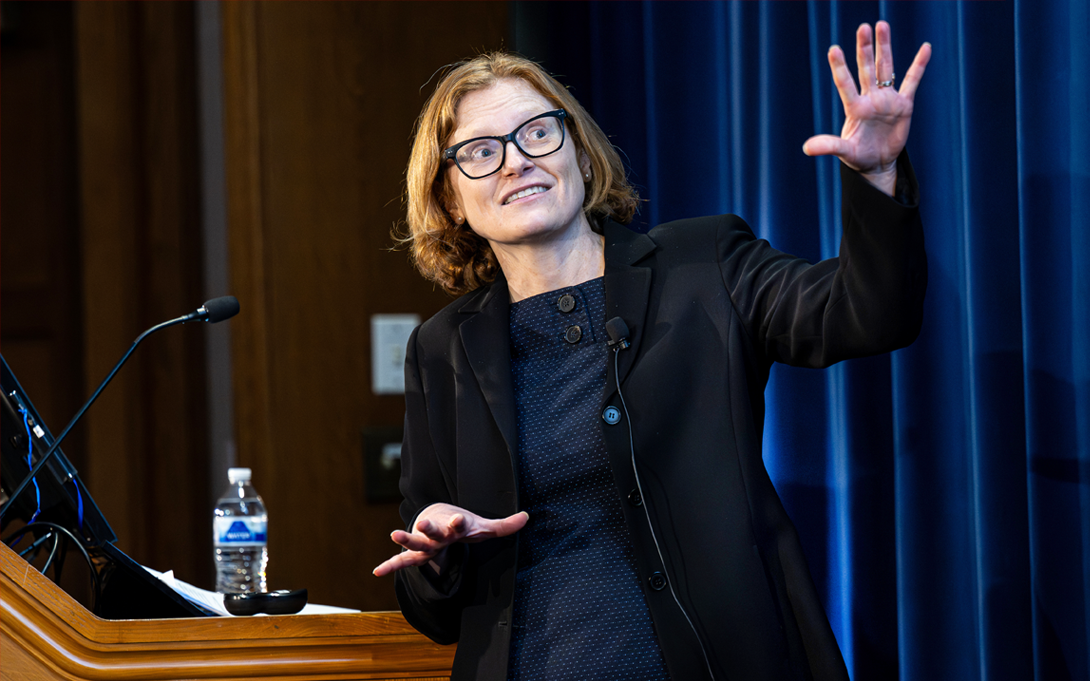 How do you ensure every child gets a strong start?
  Could new transmission lines lower your electricity bill?
 ← Read all stories in the spring 2026 edition State & Hill
