
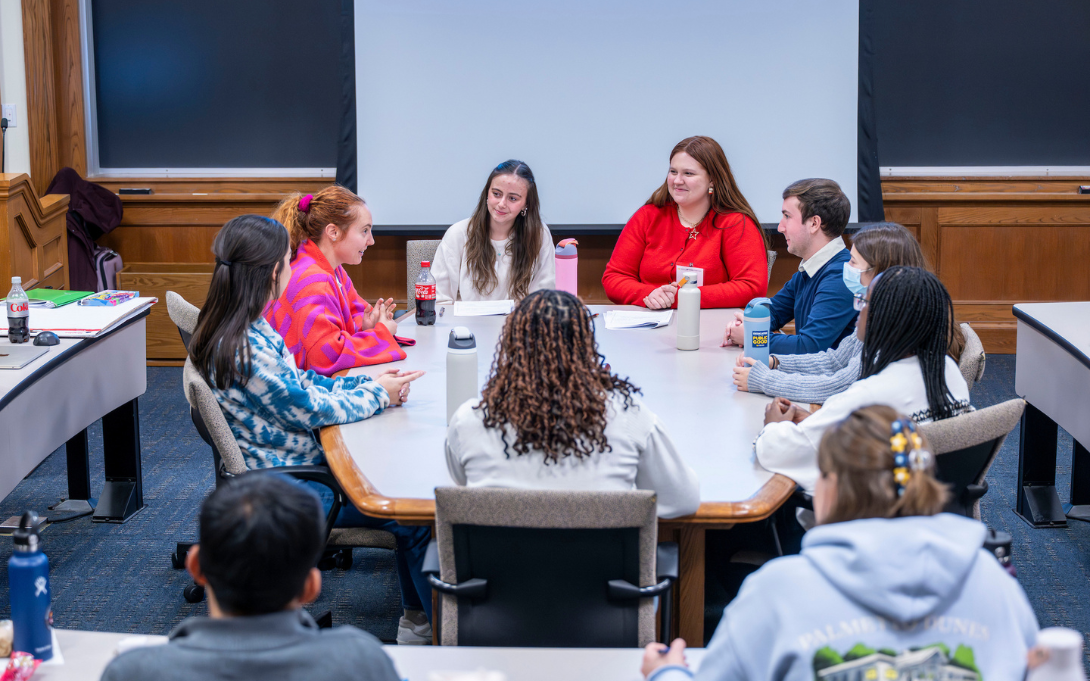
Over thirty University of Michigan students recently attended the Ford School's Constructive Dialogue Facilitation workshop, aiming to learn more about how to bridge ideological divides and bring people together through conversation.
Led by instructors from the Constructive Dialogue Institute, a nonpartisan non-profit dedicated to equipping individuals and institutions with the skills to work across differences, in coordination with the Ford School's Bridge Builders, students learned the foundational skills necessary to lead difficult conversations, including finding common ground, leading without judgment, and navigating conflicts to keep discussions on course. The two-day workshop culminated in a series of simulations, where students practiced their new facilitation skills with their fellow attendees.
Students representing the Ford School's Bridge Builders, a program designed to help students foster meaningful connections and conversations among their peers, sat in on the workshop to further develop their constructive dialogue skills. Bridge Builder Joshua Crook (BA ‘26) said the workshop showed how valuable asking questions can be in bringing people together and fostering dialogue.

"Oftentimes, leaders avoid or escalate conflict by focusing on the wrong aspects of a dialogue—especially by trying to score political points or persuade their opponents," Crook said. "Asking questions that encourage participants to share their values, personal experiences, and the reasoning behind their thoughts helps us understand new perspectives and belief systems."
Natalie Wilcox (BA ‘26), an intern at U-M's Institute for Firearm Injury Prevention (IFIP), said the event equipped her with the skills she needs to discuss emotionally charged topics like firearm regulation.
"Gun violence prevention can be a really difficult topic for different groups of people," she remarked. "This training helped me understand how to better handle the conflict that often arises in those conversations, and how to help those groups find common ground so we can approach a policy solution."

The event is part of the Ford School's Resilient Democracy initiative and is specifically designed to help policy students navigate conflict and diverging political beliefs by fostering dialogue across differences. Earlier this year, the Bridge Builders organized constructive dialogue workshops with undergraduate students, led orientation sessions for new undergraduates and master's students, and met with Robert Doar and Ted Gayer, two leaders of conservative policy organizations, to broaden their perspectives.
Dr. Stephanie Sanders, Ford School lecturer and Community and Belonging Officer, believes learning constructive dialogue skills is necessary for policy students in today's political climate. This past fall, students engaged in constructive dialogue exercises in her undergraduate Applied Learning Seminar.
"Policy work takes place in environments where disagreement is constant—across political parties, sectors, communities, and lived experiences. Technical expertise is important, but it is only part of the work," said Dr. Sanders. "Policy students benefit from being able to listen well, ask thoughtful questions, and navigate conflict without shutting others down. Constructive dialogue gives them practical tools they can use in classrooms, meetings, and professional settings to build trust, work through tension, and move ideas forward."
Attendees received a Dialogue Facilitator Certification from the CDI after completing the workshop.

By Margaret Peterman (BA ‘27)
