
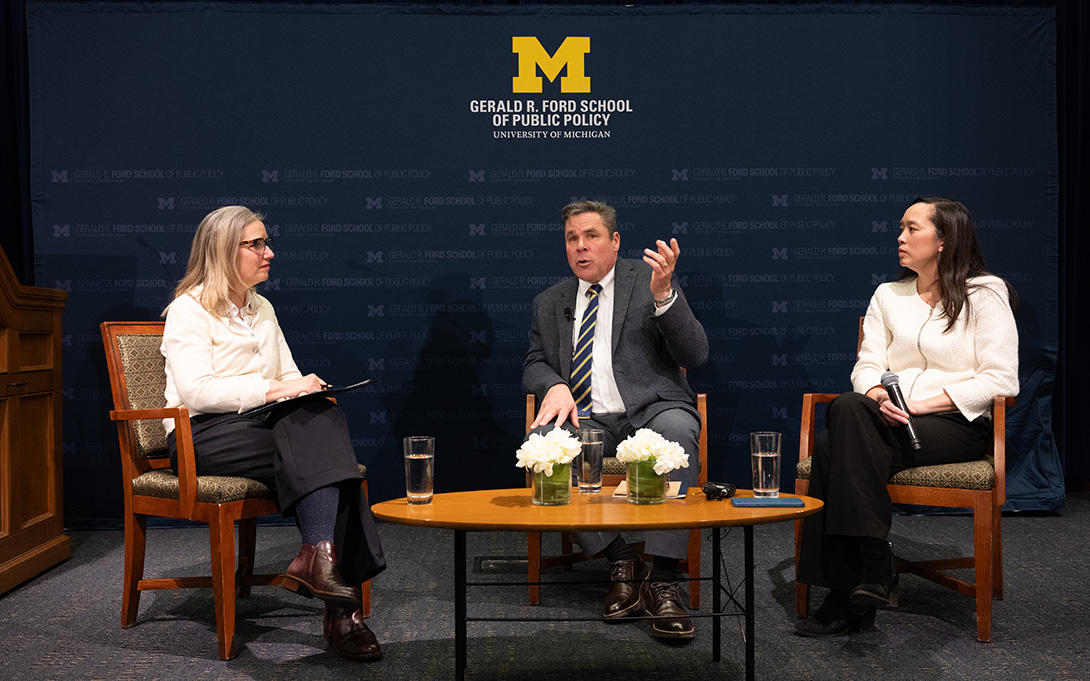
Bipartisan efforts and working across the aisle are key factors to achieve good policy, argued Michigan State Senators Stephanie Chang and John Damoose. In conversation with the Ford School's Jenna Bednar, Chang and Damoose discussed their collaboration in the Senate and why bipartisan work is important to them. The event highlighted Ford School themes of Conversations Across Differences, the Initiative for Democracy and Civic Empowerment, and building Resilient Democracies,
You can see the recording of the discussion here.
Chang highlighted how a lot of bipartisan policy is made possible through relationship building and forming coalitions. "A lot of my career has been around building coalitions, and I think that we kind of need to keep doing that and maybe in some ways get back to more of it, because we are in this time, I think, of a lot of division, but there are still so many things that we can work on together," said Chang. She noted that Michiganders, and Americans in general, want to see policies implemented, urging that the results are better when Democrats and Republicans work together.
Damoose commented on the toxic environment media has created in the government. Despite wanting to work together, policy makers are encouraged by the media to disagree and burn bridges across the aisle. Damoose stated "We are in a system that is literally designed with people cheering for us to fight each other. They look at it like a sport, watching politics 24 over seven, being fueled by media organizations that get paid by keeping us on the edge of our seat and the only way they do that is by fueling anger or fear all day long. And they want us to fight." He assured that once politicians stop fighting and begin working together, America will see real solutions to the problems at hand. "If we come in there and resist that and build relationships, it changes the whole dynamic… We can never get to the point of solving real policy issues until we fix this ridiculous divide here" Damoose affirmed.
One of the issues Chang commented on is that policy solutions have to start with the agreement that change is necessary. "There's just a lot of resistance to even the idea that change is needed. Right. Because to say that change is needed means that you are recognizing that there are people doing things wrong… It takes time, it takes the relationship, it takes conversation, it takes drilling down into the details. But it does have to start with an acknowledgment that something does actually have to change" Chang declared. She talked about the difficulty of getting collaborators on the other side of the aisle to agree that policy change is necessary. However, she added that once this agreement is made, strong, effective solutions can be formulated.
The pair of policymakers united to share that bipartisanship does not mean disaffiliating from your party or compromising your values. Damoose discussed the current lack of moderates in policymaking and why this increases partisanship. "You don't have to compromise your values. But until we get that moderate demeanor person to get really passionate about politics, we're going to get more of the same" Damoose expressed the current polarization in politics.
Water affordability, human trafficking, and domestic violence were all topics Damoose and Chang emphasized as needing bipartisan support to create impactful policy change. The policymakers assured the audience that bipartisan collaborations were responsible for a majority of their successes in the Senate.

