
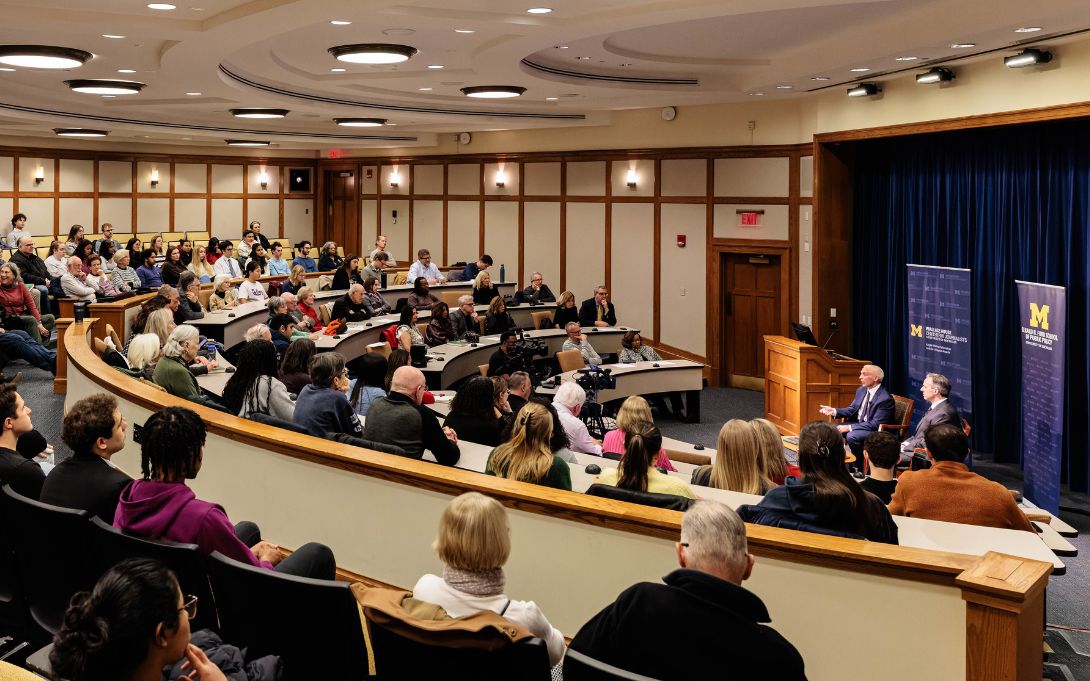
What does it take for people, communities, and democratic institutions to thrive? This fall, the Ford School will bring together a wide range of voices to explore that question—and some of the most pressing issues shaping our shared future.
Read below for highlights of our fall 2026 lineup. Events are free and open to the public unless otherwise noted; visit our events listing for the latest details, locations, registration information, livestreams, and additions to the calendar.
Democracy, civic engagement, and public leadership
Join the U-M community September 14–18 for the university's inaugural Democracy Week, a campus-wide celebration of civic participation, dialogue, and engagement. Here are several events connected to the Ford School:
How to Disagree Better: A forum with governors Spencer Cox and Michelle Lujan Grisham: Two governors from different political parties will discuss navigating disagreement, finding common ground, and strengthening American democracy. Presented by the Center for Democracy and Civic Empowerment and the Ford School, the event is free, but tickets must be reserved through the Michigan Union Ticket Office. Livestream available.
(September 14)
Democracy in global-historical perspective: Harvard Business School Professor Vincent Pons will join Ford School scholars Yousif Hassan, Don Moynihan, Yusuf Neggers, and Megan Stewart to examine democratic backsliding, resilience, and renewal across countries and historical periods. The event is co-sponsored by the International Policy Center.
(September 15)
Decolonizing imagination: Narratives, memory, and political possibility in the U.S. territories: Scholars, curators, and civic leaders will explore how memory, storytelling, and cultural practice can help communities reclaim their narratives. The event is presented by the Center for Racial Justice and co-sponsored by the Center for Democracy and Civic Empowerment, Trotter Multicultural Center, Political Science Department, Department of English Language and Literature, Center for Social Solutions, and Latina/o Studies Program.
(September 15)
Michigan elections: Local control, national scrutiny, and public trust: Former Michigan Governors John Engler and James J. Blanchard, former U.S. Representative Michael D. Bishop, and former Lieutenant Governor John D. Cherry Jr. will discuss election safeguards, public trust, and democratic participation. The bipartisan conversation is presented with the Democracy Defense Foundation. Livestream available.
(September 17)
Artist talk: Holly Bass, We Hold These Truths…: Artist and Towsley Policymaker in Residence Holly Bass will discuss her new exhibition examining how Americans celebrate, debate, and perform the nation's history. Presented with the Penny Stamps Distinguished Speaker Series and Roman J. Witt Residency Program, the talk precedes the exhibition's October 3 opening at the University of Michigan Museum of Art.
(September 17)
At Women leading local government: An interactive seminar, participants will connect with women leading communities across Michigan and explore pathways into local government leadership. The seminar is part of a growing effort to address women's underrepresentation in the field; women currently account for just 24.7% of Michigan's chief administrative officers. The event is presented by the Michigan Municipal League, 16/50 Project, Center for Democracy and Civic Empowerment, and Center for Local, State, and Urban Policy. Light refreshments will be served.
(October 14)
Social policy, economic mobility, and thriving communities
The inaugural Kohn Social Policy Conference: "What can a city do to promote human thriving?" launches a new biennial gathering focused on advancing equity and human thriving through social policy. Set in Detroit, moderated discussions will examine health, education, housing, childhood poverty, and economic opportunity—and solutions relevant to cities nationwide. Space is limited, and tickets are required.
(September 18)
Poverty Solutions, U-M's action-based research initiative focused on preventing and alleviating poverty, will host four events, several part of the Real-World Perspectives on Poverty Solutions speaker series. All will be available via livestream.
Lessons learned from designing and evaluating Ann Arbor's guaranteed income pilot: Kristin Seefeldt will share insights from developing and evaluating a program that provides direct cash assistance to local residents. (October 2)
cityLAB's innovations for affordable housing: UCLA's Dana Cuff will share lessons from innovative housing research and practice. (October 23)
Designing for dignity: Strengthening food assistance amid policy threats: Kate Bauer and Taylor Moore, director of Food Rescue of Northwest Michigan, will discuss how programs and policies can preserve dignity and expand access to food. (October 30)
Cash plus psychosocial interventions for economic mobility: Catherine Thomas will examine how pairing cash assistance with psychosocial interventions can address forces that perpetuate poverty and inequality. (November 13)
Diplomacy and international affairs
Twenty-five years after the September 11 attacks, award-winning journalist and author Peter Bergen joins the Ford School's Javed Ali for 25 years after 9/11: Reflections on the U.S. war on terror. They will examine the lasting implications of 9/11 for U.S. national security, discuss the evolving terrorism landscape, and consider themes from Bergen's book, All the Presidents' Wars: Twenty-Five Years of America's War on Terror. This Josh Rosenthal Education Fund Lecutre is presented by the Weiser Diplomacy Center. Livestream available.
(September 30)
How is global competition reshaping U.S.–Africa relations? Presented by the Weiser Diplomacy Center, the two-day conference Shifting tides: The U.S.–Africa relationship amid global competition will explore global governance, climate and human capital, great-power competition, peace and security, and Africa's economic future. The program will include a keynote address, expert roundtables, and an executive networking reception.
(October 12–13)
At Diplomacy and the Indian subcontinent, Ambassadors Robert Blake, Gerald Feierstein, and Robin Raphel will examine how the United States can navigate its security, economic, and strategic interests in South Asia, including its diplomacy involving India, Pakistan, Bangladesh, Afghanistan, and Kashmir. The Weiser Diplomacy Center presents this Ambassador's Forum in partnership with the American Academy of Diplomacy.
(October 21)
Former U.S. Senator and Ambassador to Türkiye Jeff Flake will deliver the eighth annual Arthur Vandenberg Lecture with a talk centered on American diplomacy in a divided era. Drawing on his experience in Congress and diplomacy, Flake will explore how bipartisan cooperation can advance U.S. interests, strengthen alliances, and navigate global challenges. Livestream available.
(November 16)
Science and technology policy
As artificial intelligence moves further into health care, policymakers face consequential decisions about how it should be developed, governed, and used. At The promise, perils, and policy options for AI in health care, Science, Technology, and Public Policy visiting scholars Katerina Sideri and Andreas Panagopoulos join Professor of Law Nicholson Price to examine the opportunities, challenges, and policy implications of AI in health care. STPP Director Shobita Parthasarathy, an expert on the governance and public-interest implications of emerging technologies, will moderate the conversation.
(October 26)
Ford School Community Read
This year's Community Read selection is Demon Copperhead by Barbara Kingsolver, a deeply human story of growing up in Appalachia that raises important questions about poverty, opportunity, resilience, addiction, education, and the systems that shape people's lives and futures.
Students, faculty, and staff will engage with the novel through courses, discussions, co-curricular activities, and other programming throughout the academic year. Questions may be directed to [email protected].
Stay connected
We are still adding to the fall lineup, including programming connected to this year's Community Read. Visit the Ford School's events listing for the newest programs, event details, registration information, and livestream links. You can also discover additional programming led by the Ford School's research centers.
Subscribe to our mailing list for announcements and reminders, and connect with us on LinkedIn, Facebook, Instagram, X, and Bluesky. Follow the Ford School on Flickr for photos from recent events.