
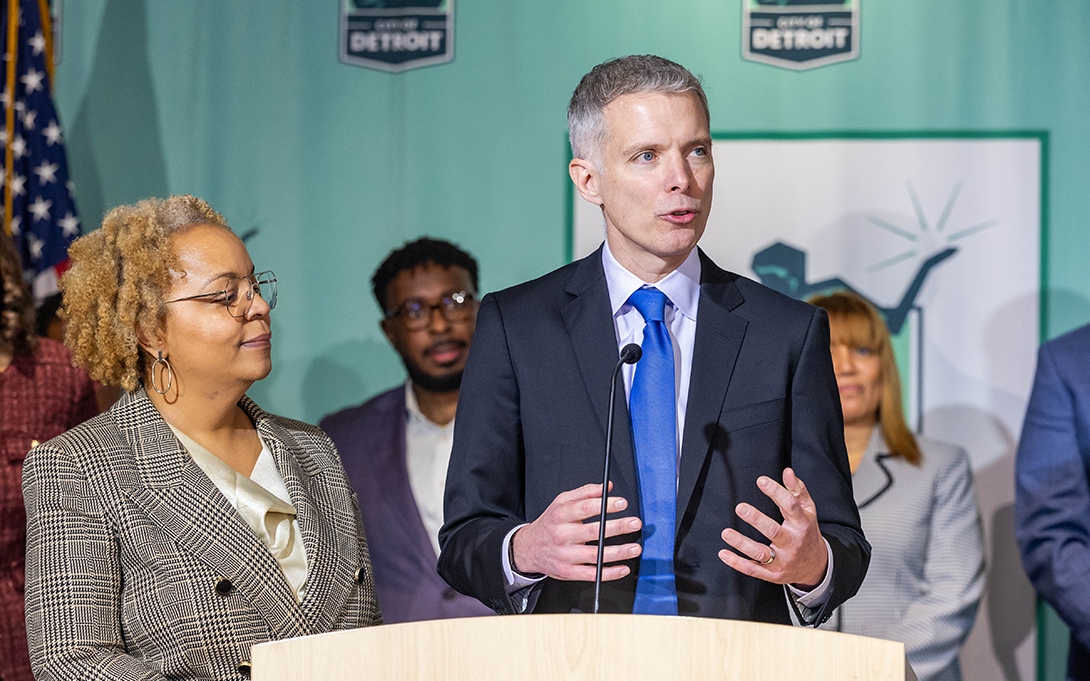
In this Q&A: His data-driven vision targets systemic change
In January, Luke Shaefer, Hermann and Amalie Kohn Professor of Social Policy and Social Justice, was appointed chief executive of Health, Human Services & Poverty Solutions for the City of Detroit. He is now responsible for the Detroit Health Department, the Office of Immigrant Affairs and Economic Inclusion, and a new Department of Human, Homeless, and Family Services. He plans to return to his faculty post after a two-year leave from the university.
Mayor Sheffield created a new, broad-based human services department. What difference will this make for Detroiters?
Mayor Sheffield's unified strategy is so essential. In addition to overseeing the new department of Human, Homeless and Family Services, my role will lead Detroit's Health Department—one of the city's most important departments, providing critical services to many residents. We will work in tandem with departments across the city, and with the state, to create a new doorway by which Detroiters will be able to access the range of housing, homelessness, health, and behavioral health services we have to offer. We will look for synergies, reduce fragmentation, and increase impact.
Cities often lack individualized approaches to real issues on a population level, and I am energized about building a strategy of household-level interventions to deliver real impact for Detroiters. We're going to have a special focus on reducing child poverty and will do everything we can to lift our kids up. We'll also focus relentlessly on delivering real resources to Detroiters with dignity and respect.
What challenges do you anticipate in your new role, and how will you approach them?
The challenges are complex. But we know something fundamental: poverty is a root cause of homelessness, poor health, and family instability.
Poverty is not an individual failure, but the result of interlinked systems—housing, education, labor markets, health care, and the justice system—that too often fail families with low incomes. A systems approach can feel overwhelming, but I firmly believe that systems can be redesigned. They can work better. They can empower families to live healthy, full lives.
This work will require partnerships across city government—from HR to procurement— and collaboration with universities and our state partners, especially the Michigan Department of Health and Human Services, as well as Detroit's best-in-the-nation nonprofit and philanthropic community.
We will learn from what works in other cities. We'll double down on the things we're doing that are working, and rigorously examine our programs to understand where people get stuck, where systems break down, and how we can improve them.
How will your experience with leading U-M's Poverty Solutions inform your approach to working with city and community stakeholders?
Because I am a nerdy professor, I love data. A good chart or table makes me feel warm and fuzzy inside. My colleagues are already learning that I always smile widely when they bring me new data about our programs. Everything we do in these departments will be data-driven and guided by evidence and accountability. Some changes will be big. Others will be small but meaningful. Our goal will be to do something every day to make our programs work even better.
For nearly a decade, my team at U-M Poverty Solutions has worked alongside Detroit partners on housing stability, violence prevention, and other poverty solutions—learning from residents, community organizations, and frontline workers across the city. In this role, I will listen deeply and broadly, because the goal is a citywide, data-driven approach to improving health and opportunity that reflects the lived experiences of Detroiters.
Related spring 2026 State & Hill stories
 Can Scholarship Shape Democracy?
  How do you ensure every child gets a strong start?
  Michigan redefines support for new families
 ← Read all stories in the spring 2026 edition State & Hill
