
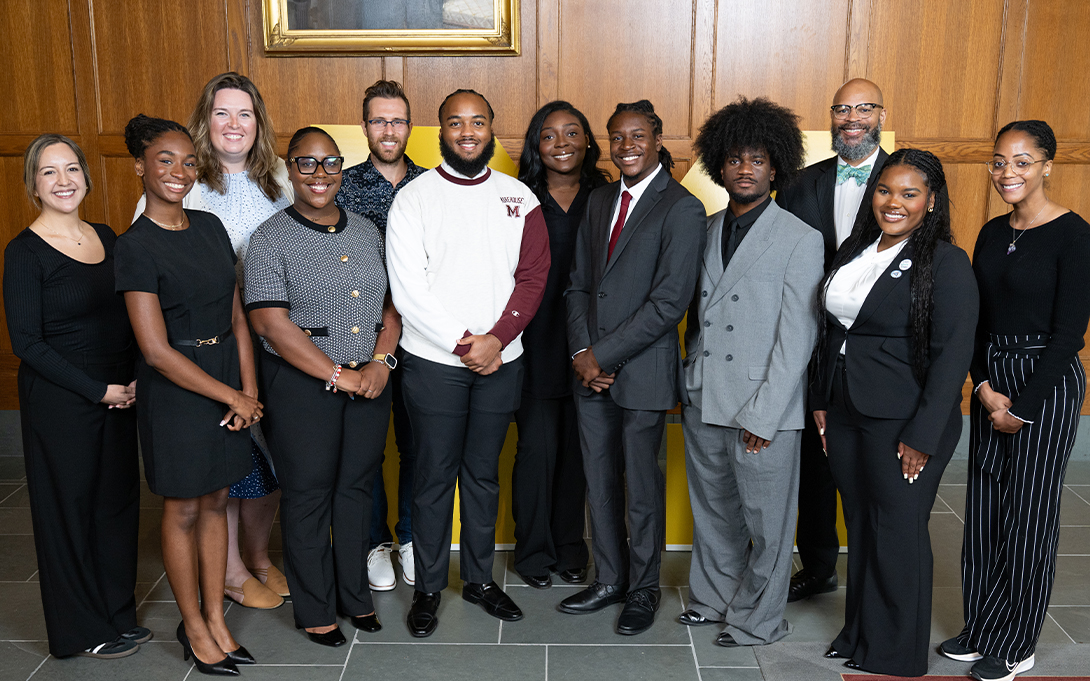
The phrase on Joasia Jacobs' pin—"Talk data to me"—could have served as a motto for this summer's ASPIRE cohort.
The 2026 Applied Social Policy Internship and Research Experience, known as ASPIRE, brought students from Spelman College and Morehouse College to the University of Michigan for hands-on training in applied social policy research. Hosted by the Youth Policy Lab at the Gerald R. Ford School of Public Policy and the Institute for Social Research, the program is designed to help students strengthen quantitative analysis skills, explore careers in public policy research, and build connections across the university and beyond.

This year's cohort included Spelman students Toni Flemming, Joasia Jacobs, and Olivia Liddie, and Morehouse students Donovan Correll, Chavous Langhorn, and Vincent Patterson. Over the summer, each fellow worked with a mentor and Youth Policy Lab faculty and staff to develop a research project connected to youth outcomes, school experiences, and public policy.
For Jacobs, a rising senior studying sociology and Comparative women's studies, the pin captured one of the central lessons of the summer.
"Research is either numbers or words, but you have to bring them together to show lived experience," Jacobs said.
By the end of the eight-week program, the students' presentations had converged around a common theme: how schools can better support students, particularly Black adolescents, as they navigate mental health challenges, trauma, and trust in school systems.
The students explored topics ranging from absenteeism and bullying to parental death, mental health stigma, student trust in authority, school-based counseling, and peer support.
Olivia Liddie, a senior psychology major, examined how student victimization and feelings of comfort or safety in school relate to school reluctance and avoidance behaviors. Her project considered factors such as teacher-student relationships, social comfort, perceived safety, bullying, discrimination, and anxiety. Liddie's analysis pointed to the importance of understanding absenteeism and tardiness not simply as attendance issues, but as possible signals of students' mental health, safety, and sense of connection at school.
Senior economics major Toni Flemming studied the impact of parental death on adolescent mental health, behavior, and academic outcomes, with attention to differences by gender. While Flemming found that parental death was associated with mental health and behavioral outcomes, the relationship with academic outcomes was less straightforward, suggesting that school can sometimes serve as a source of structure and normalcy for grieving students.

Joasia Jacobs focused her research on trauma exposure, mental health stigma, and barriers to mental health service use among Black adolescents. Her work examined how adverse childhood experiences and stigma may shape whether students seek support, and how those experiences differ by gender. Jacobs found that school-based mental health resources were underused, even when students reported that the resources could be helpful, and she recommended strategies such as anti-stigma programming, trauma-informed training, wellness screenings, and improved service navigation.
For Jacobs, the ASPIRE experience helped make research feel both practical and possible.
"ASPIRE was very much like a 9-to-5, hands-on research experience," Jacobs said. "It was a soft launch into the real world. I was able to visualize myself in the world of research through this internship."
Vincent Patterson, a senior psychology major, examined student trust in authority and how experiences with punishment or legal-system involvement may shape that trust. His project began from the premise that trust is foundational to education. Students spend much of their lives in schools, and their relationships with teachers and other authority figures can affect their sense of safety, belonging, and willingness to engage academically. Patterson's presentation raised questions about whether students perceive authority as legitimate and supportive, or primarily as punitive.
Donovan Correll, a rising junior interested in attending law school, studied the relationship between reported arrest history, mental health, and students' use and perceptions of school-based mental health resources such as counselors, social workers, and psychologists. His findings complicated the common assumption that simply increasing access to school counselors is enough. Students with more severe anxiety or depression were less likely to view some services as helpful, and Correll suggested that mental health referrals may sometimes be perceived by students as disciplinary consequences rather than supportive interventions.

Rising senior Chavous Langhorn focused on peer support, prosocial behavior, and bystander intervention among high school students. His project explored whether students' comfort talking with friends, anxiety, and depression were associated with their willingness to help a peer who was struggling. Langhorn emphasized the importance of building classroom and school climates where empathy, vulnerability, and peer support are cultivated intentionally.
"When we look out for other people, more people will look out for other people," Langhorn said during his presentation.
Together, the projects underscored the role schools can play not only in responding to students' academic needs, but also in recognizing trauma, building trust, and connecting young people with meaningful support.
Throughout the summer, ASPIRE fellows met with leaders across public policy, philanthropy, public health, law, and youth justice. Speakers included, among others, Washtenaw County Public Defender and Spelman alum Delphia Simpson; Marijata Daniel-Echols of the W.K. Kellogg Foundation; Spelman alum Adena Hill and Ashley Johnson of the Kresge Foundation; Dexter Mason of Change Collective; Sara Elhasan of Dearborn Public Health; Linh Song of the Song Foundation; Ford School and Spelman alum Terri O'Neal of the Oyster Knife Lab; and Jason Smith of the Michigan Center for Youth Justice.
The speaker sessions, along with mentorship, activities with other summer research program participants, workshops, and community service, helped students see multiple pathways into social policy research. Fellows said those connections were among the most meaningful parts of the summer.
"Having a mentor who's well connected and the whole YPL staff willing to have conversations and coffee chats—I can't compare anything else to that," Jacobs said.

ASPIRE's growing network was also visible through two returning fellows in the audience. Tyler Mathieu, a member of last year's ASPIRE cohort, returned to connect with current students before beginning the Ford School's Master of Public Policy program this fall. Mathieu said ASPIRE introduced him to public policy and helped shape his graduate school plans.
"Before my summer at the Ford School, I really didn't even know what public policy was," he said. "I was interested in education, but having this experience opened my eyes to how broad public policy is. Once you find your niche, you can really make an impact. My goal is to do something that's for the better good of society, so this is the perfect place to start."
He added that he remains interested in education policy, urban development, and community building.
Dean Celeste Watkins-Hayes emphasized that ASPIRE is more than a summer learning program; it is an investment in the future of public policy research.
"At the Ford School, we believe that expanding access to rigorous policy research experiences is essential to developing the next generation of leaders. Students from Spelman College and Morehouse College bring analytical rigor and intellectual curiosity that strengthen applied policy research and enrich our academic community. Through ASPIRE, we are creating meaningful opportunities for students to engage in research, mentorship, and public service — while building lasting research partnerships with institutions that produce exceptional policy talent."
The program is supported by the Ford School, the Institute for Social Research, and the Survey Research Center, as well as a generous contribution from Ronda Stryker, a member of the Spelman College Board of Trustees whose philanthropic interests include empowering women and supporting student enrichment programs at colleges and universities.
"I was inspired by the depth, care, and thoughtfulness the ASPIRE fellows brought to their research," Stryker said. "I support ASPIRE because it gives talented students from Spelman and Morehouse the opportunity to see themselves as researchers, policy thinkers, and leaders whose work can improve lives."
As the cohort concluded its summer in Ann Arbor, the fellows left with new technical skills, professional connections, and a clearer sense of how data can inform policy decisions affecting young people's lives.
