
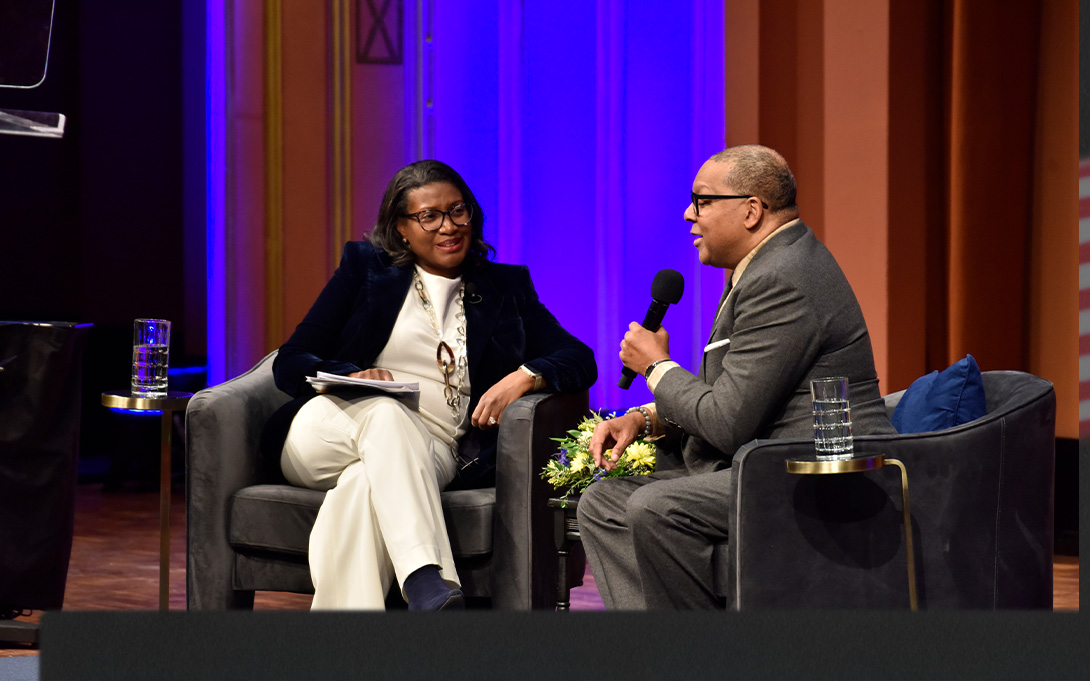
When Wynton Marsalis speaks, civics and jazz become one and the same. In between musings on society and politics, he peppers bits of rhythm and melody. The conversation itself becomes a piece of music, and even in a crowded auditorium, it somehow feels like he's playing it for an audience of one.
Taking the stage at Rackham Auditorium on February 4th alongside Dean Celeste Watkins-Hayes, Marsalis reflected somberly on the state of society. "The general condition of the country is a struggle," he began, but explained that this is the case for every generation. His grandparents were sharecroppers, his father struggled financially as an artist, and Wynton himself came up in grade school during the integration era. To Marsalis, "struggle is the backdrop for many people," yet at the same time, "we are so fortunate to be here. Even those of us who struggle."
You can see the conversation here.
Throughout the afternoon, it was clear that Marsalis's connection to music runs deep, but it was playful at times, too. Watkins-Hayes reflected on this: "It's not only the passion [to play for the sake of playing], but what music gives you in terms of that thing to hold onto in your soul." Marsalis nudged her to sing a little, and she briefly broke into "I Don't Feel No Ways Tired" to laughter and applause. "It [music] doesn't have to be serious," said Marsalis, responding by sharing little bits of silly songs he made up for his kids.
Perspective became a common theme for the conversation. He told stories about how people sitting in the same room can see completely different things, connecting it to playing jazz. A good jazz player has "the ability to hold thoughts that are opposites in [their] mind at one time to develop [their] acuity over a lifetime," seeing life itself like a mosaic. The same is true for civic life—society is at its best when its citizens discern and discover opposing points of view.
Marsalis spoke at length about corruption, in politics and jazz. "This system does not work unless you are educated in how it works. Jazz is the same way," he said. "This system is corrupted. So is jazz. This system needs reform. So does jazz. This system has a lot of space for individual freedom. So does jazz. But the collective space—which jazz has—is the one that has been the most corrupted and is the least known. So is democracy." Jazz and civics are both learned piece by piece, building off fundamentals and structures. Both have people who don't care for the rules and are out to make it about themselves. In both arenas, he said, "corruption takes many forms. And one of the most important forms of corruption is getting to the young early so they no longer understand [what] is corrupt. They just think it's normal . . . they're [politicians] not even hiding it."
Marsalis theorized that in jazz, corruption happens when the musician tries to make the art about themself, or about making money—in politics, it's exactly the same. The answer to corruption is education. Being able to identify what you see in front of you is an area where society is failing, Marsalis argued, and that acuity should be instilled more strongly into young people. He said, "Don't just look at that one person, because he didn't start the corruption. He's just better at it . . . Enough people allow it to happen."
The conversation turned to the future, with discussion about Wynton's work on his soon-to-be released Symphony No. 5, "Liberty," commissioned by The Philadelphia Orchestra for the nation's 250th anniversary. Asked about his creative process, Marsalis started, "Well, I sing voice notes…" Then rather shyly pulling out his phone, he scrolled through the long list of voice memos that formed the basis for his next piece. He talked about the symbols of American music and society he is incorporating into the music: trains as a metaphor for freedom, the optimism found in a march, the feeling of New Orleans blues. He spoke with enthusiasm for the creative process, making it clear that he intends for his music to be ambitious—something that brings people together.
"Wynton Marsalis in Conversation" ended up being more than just a talk about politics and music; it offered powerful arguments for becoming better listeners and more careful thinkers. While his professional career is winding down—Marsalis announced last month that he would step down as Artistic Director of Jazz at Lincoln Center—he remains devoted as ever to preparing the next generation of musicians and leaders to work for the public good.
Watch the full conversation here.
