
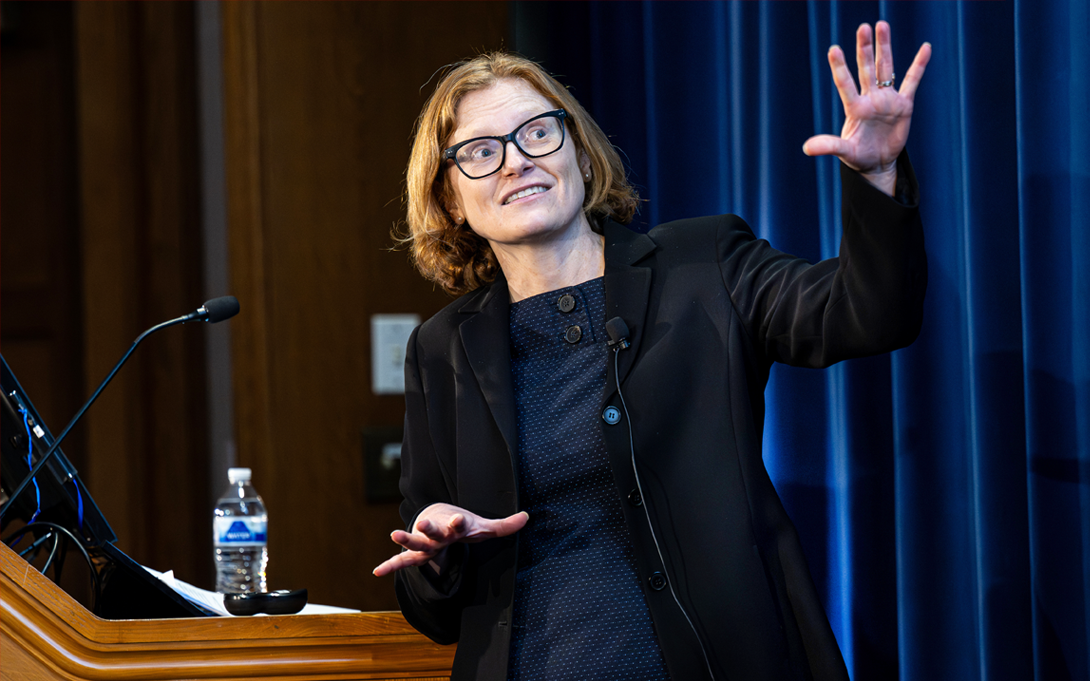
Weiland's policy-driven research brings proven results to classrooms across the U.S.
In the rural West Virginia holler where Professor Christina Weiland grew up, the nearest child care center was at least 45 minutes away. So, until she was old enough for kindergarten, a revolving cast of family members took turns caring for Weiland while her parents worked.
"I played outside a lot, and got to know a lot of people in my family well," says Weiland, the Karl and Martha Kohn Professor of Social Policy at the Ford School. "There were not a lot of technological distractions—we still don't have cable in the holler—so I spent my time in the creek and in the woods, using my imagination."
Weiland looks back on her childhood fondly. She thrived in public schools and became the first person in her family to graduate from college. "My teachers were wonderful," she says.
I was raised to believe—and still do—that education is the best opportunity to make a better life for your family."
Christina Weiland
Today, Weiland is recognized as one of the nation's foremost experts in early childhood education, and knows that lack of access is a disadvantage. In fact, data show that about half of U.S. children enter kindergarten with low proficiency in math and literacy, and these gaps are even wider among lower-income and minority families.
"Someone might argue, ‘We're spending all that money in K–12. We'll just catch them up,'" Weiland says. "But when you look down the road, you can see that most of the very large gaps in high school between more and less advantaged children was already baked in when they were five years old. This is what we're trying to change."
Weiland has dedicated her career to ensuring that students across the country receive high-quality early childhood education. In addition to her professorship, she co-directs the Ford School's Education Policy Initiative and holds an appointment at the Marsal Family School of Education.
"In a nutshell, my work supports policies that promote better outcomes for kids ages 0 to 8," she says. "It's about getting kids off to the best start possible, when their brains are developing the fastest and they're most sensitive to their environments."

Her expertise in how to improve large-scale preschool programs runs deep. For nearly two decades, she has partnered with Boston Public Schools to understand how their universal Pre-K program is making a difference on long-term outcomes. She found that children who participate score higher in math and are more likely to take Algebra 1 in eighth grade, and be on track to complete advanced coursework in high school. "This is one of those opportunity doors that we want kids, if they are ready, to walk through," she says.
Beyond Boston, Weiland partners with leaders in Washington DC, Michigan, Mississippi, Maine, and other states, using research to improve the quality of their early childhood programs. Depending on community needs, her team develops policy blueprints, tracks classroom quality and student outcomes, and publishes case studies that describe how others can replicate results.
Our case studies describe what implementation of evidence-based models looks like and how they made change happen. We know that delivering on high-quality at large scale is complicated. Lots of things can go wrong, and logistics can bog you down."
Christina Weiland
In Michigan, with their mentees, Weiland and Brian Jacob, Walter H. Annenberg Professor of Education Policy, have shown that Michigan's transitional kindergarten program boosts kindergarten readiness and math scores through third grade.

She, Jacob, and UM PhD student Jordan Berne (now at RAND) worked together to also quantify the impact of Michigan's third-grade reading law, which aims to boost literacy by requiring children who fall behind to repeat a year in school. Weiland and Jacob found that the law helped children improve—but not because they were held back. Instead, struggling students received extra support, such as tutoring sessions and reading materials, which helped them catch up and avoid retention.
Looking ahead, Weiland is focused on expanding high-quality early education for all families—especially those with lower incomes.
"Sometimes it's really practical, like figuring out how to train hundreds of teachers in effective strategies," she says. "At the end of the day, the goal is to deliver a strong experience for kids."
Written by Sheri Hall
Related fall 2025 State & Hill stories


← Read all stories in the fall 2025 edition State & Hill

