
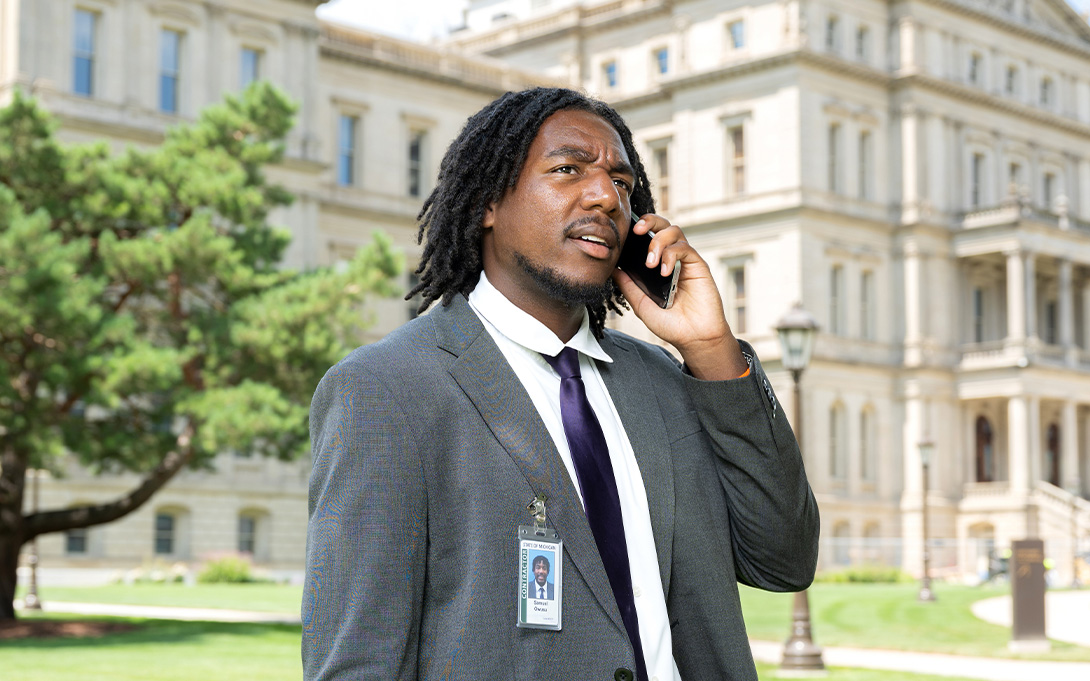
Samuel Owusu (MPP '25) helps Michigan strengthen early childhood data systems so leaders can see if public investments are reaching the children and families they are designed to serve
In a transitional kindergarten classroom, a teacher may see a child gain confidence. At home, a family may see what that extra year of early learning made possible. But for policymakers, those individual experiences are essential—but they are only part of the answer. To understand whether a program is working statewide, those experiences have to be visible in the data.
That was the challenge Samuel Owusu encountered in 2021 as a research data analyst at the Ford School's Education Policy Initiative (EPI). His team was evaluating how Michigan's transitional kindergarten, or Young 5s, programs shaped children's later success in school. But before they could examine the outcomes, they needed to know who participated.
The data did not arrive neatly labeled because there was no clear guidance on how to report students. Districts appeared to report students in different ways, leading the team to investigate how programs were coded and whether student records consistently reflected participation.
"Before you even analyze the data," Owusu said, "you have to check how people are entering it and make sure it's accurate."
The project also taught Owusu that the numbers driving policy conversations are rarely as simple as they look. To understand which children may have participated in transitional kindergarten, the team examined a web of administrative indicators, including birth dates, waiver rates, attendance records, and grade progression.
"When you see a simple statistic in a policy report, it may look straightforward," Owusu said. "But often, that number is built from many data points, merged and analyzed in multiple ways to get closer to the source of truth."
Sharpening his analytical tools
Long before Owusu worked with administrative data, he was a public school student trying to understand why educational opportunities varied so widely from one community to another. He saw how students' experiences were shaped by where they lived, what resources their schools had, and whether teachers had the support they needed. When his high school teachers went on strike, the stakes became personal.
At first, he thought advocacy meant raising your voice loudly enough to force change.
"In my mind, all we needed to do was to make some noise, yell at your senator, your governor, or your representative to make a change, and that'll be it," he said.
The Ford School's Public Policy and International Affairs Program Junior Summer Institute (PPIA JSI) showed him how data could strengthen advocacy. In summer 2020, between his junior and senior years at Davidson College, Owusu participated in the program remotely and used federal data to examine racial and socioeconomic disparities in in-school suspension rates. The experience, he said, gave him his first exposure to the "analytical toolkit" needed to push for substantive policy change.
The Ford School helped me interrogate everything I thought I knew about public policy," Owusu said. "I came in with very preconceived notions about how policy gets made."
That training deepened when Owusu moved to Ann Arbor after college to join the EPI research team. Drawn by the opportunity to work with student-level data and learn from Ford School faculty Kevin Stange and Christina Weiland, he strengthened his technical skills while learning how to form effective policy questions, collaborate on analysis, and navigate the complexity of real-world administrative data.
After two years with EPI, Owusu pursued a Master of Public Policy at the Ford School to deepen his policy analysis skills and broaden his understanding of education systems. The MPP, he said, offered the flexibility to explore connections across early childhood education, higher education, and workforce development.
"We really need folks who have strong analytical toolkits and can tell the right story using evidence," he said.
Building systems that serve people
Today, Owusu helps Michigan understand whether its birth-to-five investments are reaching children and families. As a policy fellow at the Youth Policy Lab embedded with the Office of Early Childhood Education within the Michigan Department of Lifelong Education, Advancement, and Potential (MiLEAP), he supports projects spanning data governance, curriculum and professional development, coordinated enrollment, and the early childhood workforce.
Much of that work happens behind the scenes: defining data and reporting rules, understanding administrative systems, and coordinating enrollment processes across agencies.
Without high-quality data, we don't have tools for policymaking."
One major effort involves mapping where early education data lives across state agencies and programs—from pre-K and licensing to workforce registries, child care subsidies, Head Start, home visiting, and other services that impact young children and their families.
In another project, he is helping build a database for a state wage pilot for early childhood educators. The pilot examines whether wage supports can help more educators stay in the field, a key challenge for families seeking stable, high-quality care. Owusu's role is to ensure the data is accurate, consistent, and useful for understanding the pilot's impact.
Owusu also supports coordinated enrollment, an effort to make it easier for families to find early childhood programs. For parents seeking care, the current landscape can be exhausting, often requiring multiple calls, waitlists, and applications. Better data systems could help the state understand not only where seats exist, but also what families actually need and value: quality, location, affordability, and convenience.
Owusu sees the early education system as critical community infrastructure. If educators cannot afford to stay in the field, families may struggle to find care. If families cannot find care, parents may be unable to work. And if children cannot access early learning opportunities, the effects ripple far beyond the classroom.
Public policy is personal, and it's more personal than most of us really think," Owusu said. "It's your trash pickup. It's your ability to go vote. It is your education and the books you have in your school."
That is why the people behind the numbers matter. Owusu's work is technical, but its purpose is not. When data systems work well, public investments can more effectively reach the children, families, and educators they are designed to serve.
By Rebecca Cohen (MPP '09)
Related Fall 2026 State & Hill stories
 Evidence about school cell phone bans
  People of the machine
  Practical support for Michigan communities
 ← Read all stories in the fall 2026 edition State & Hill